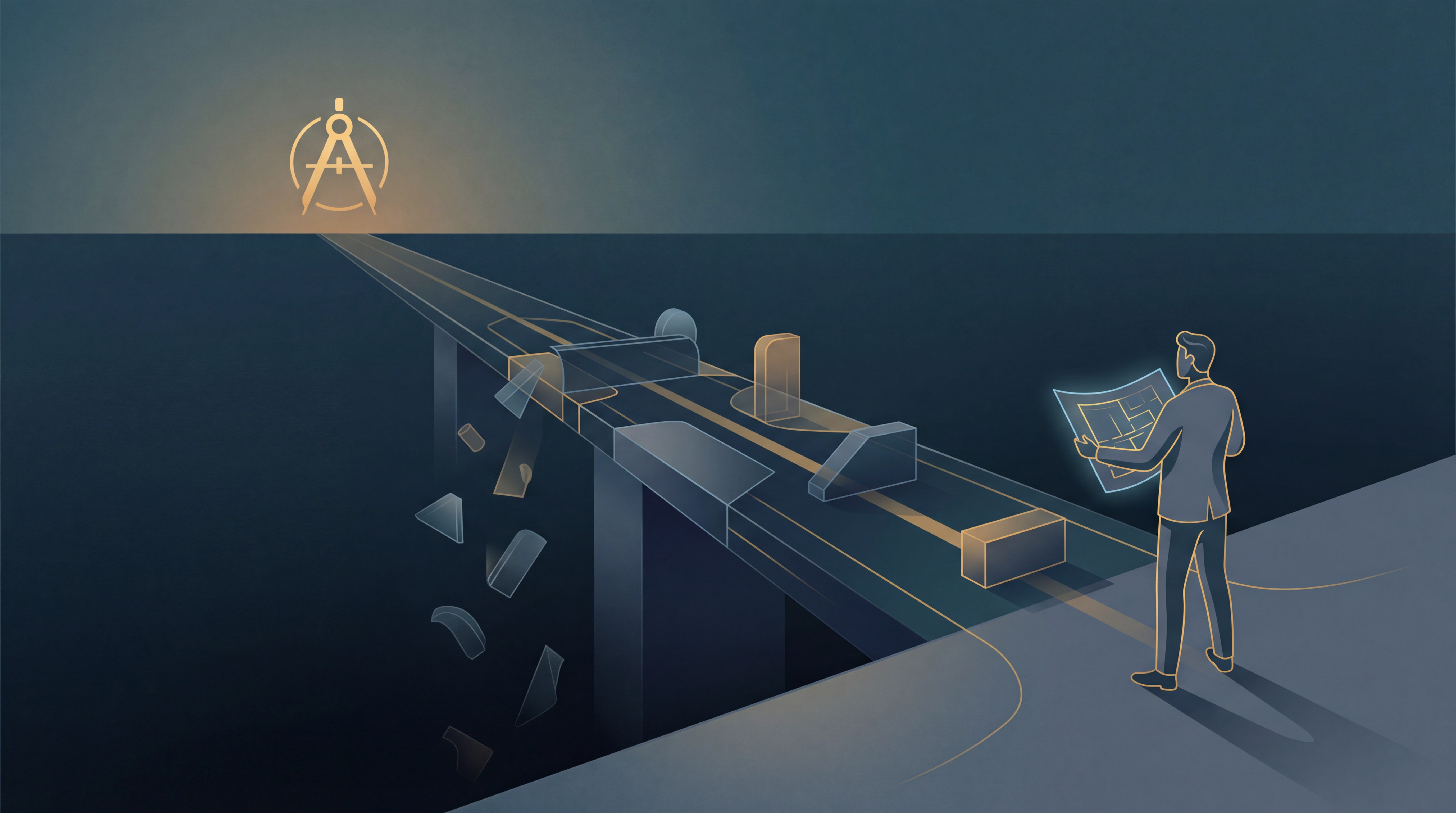
How to Scope an MVP for Technical Feasibility
Building a Minimum Viable Product (MVP) is a delicate balance between ambition and reality. Your vision might be a sprawling, feature-rich platform, but the goal of an MVP is to launch the smallest possible product that solves a core user problem and provides valuable feedback. For small engineering teams, getting this scope right is critical. Over-scoping leads to burnout and missed deadlines; under-scoping can result in a product that isn't viable.
This guide outlines a structured process, mirroring internal startup evaluation best practices, to help your team define and scope an MVP that is not only valuable to users but also technically feasible to build with your available resources.
Step 1: Define the Minimum Viable Feature Set
Before you can assess feasibility, you must define what you're building. The key is to be ruthless in your prioritization. An MVP is not a smaller version of your final product; it's a focused tool designed to test a single core hypothesis about your user's problem.
Prioritize Around the Core User Journey
Start by answering this question: What is the one critical job a user must be able to accomplish with your product? Map out this single, essential user journey. Everything else is secondary.
Use a simple prioritization framework to categorize features:
- Must-Have: These are features that are absolutely essential for the core user journey to function. Without them, the product is unusable for its primary purpose. (e.g., For a food delivery app, this is searching for restaurants, adding an item to a cart, and checking out).
- Should-Have: These features add significant value but are not critical for the initial launch. They can be fast-follows. (e.g., Saving favorite restaurants, re-ordering a past meal).
- Could-Have: Nice-to-have features that improve the user experience but can be added much later. (e.g., A loyalty points system).
- Won't-Have: Features that are explicitly out of scope for the MVP. Listing these helps prevent scope creep. (e.g., Catering orders, group ordering functionality).
Your MVP feature set should consist only of the Must-Haves. Everything else goes into the backlog.
Step 2: Conduct a Technical Feasibility Assessment
With a lean feature list in hand, you can now determine if you can actually build it. This step is about moving from a list of ideas to a high-level technical plan.
Create a High-Level System Diagram
You don't need a formal, exhaustive architecture document. A simple whiteboard or digital diagram is sufficient. Sketch out the main components of your system:
- Frontend: Web app, mobile app, or both?
- Backend: What services or APIs are needed to power the frontend?
- Database: What kind of data needs to be stored?
- Third-Party APIs: What external services will you rely on (e.g., Stripe for payments, Twilio for SMS, Google Maps for location)?
This exercise forces you to think through the technical interactions and highlights areas of high complexity early on.
Spike and Prototype High-Risk Components
Identify the riskiest parts of your technical plan. Risk can come from:
- Unfamiliar Technology: Using a new programming language, framework, or database.
- Complex Algorithms: Implementing a novel recommendation engine or data processing pipeline.
- Third-Party Integrations: Relying on an API that is poorly documented or has unclear performance limits.
A technical spike is a time-boxed investigation (typically 1-3 days) to research and build a small proof-of-concept for a high-risk feature. The goal isn't to write production-ready code, but to answer a specific feasibility question. For example: "Can we achieve the required video streaming latency using this open-source library?" Spikes reduce uncertainty and prevent you from committing to a path that is technically unviable.
Step 3: Map Technical Risks and Dependencies
Every project has risks and dependencies. The key is to identify them proactively so they don't become surprise blockers later. This is especially critical for a small team where one person being blocked can halt progress.
Identify and Grade Technical Risks
Create a simple list or table of potential technical risks. For each risk, assess its likelihood and potential impact.
- Performance Risk: "Our database query to fetch user activity might be too slow once we have 1,000 users." Mitigation: Index the database and load test a prototype.
- Integration Risk: "The third-party shipping API we need has a very low rate limit." Mitigation: Contact their support to clarify limits or find an alternative provider.
- Scalability Risk: "Our serverless function architecture might become too expensive at scale." Mitigation: Set up billing alerts and choose cost-effective instance types for the MVP.
- Skill Gap Risk: "No one on the team has experience with mobile app deployment." Mitigation: Allocate time for learning or use a simpler managed service like Expo for React Native.
Map External Dependencies
List every external service, library, or API your MVP depends on. For each one, consider:
- Cost: What is the pricing model? Is there a free tier suitable for an MVP?
- Reliability: Is the service stable? Does it have a public status page?
- Documentation: Is the documentation clear, complete, and up-to-date?
- Lock-in: How difficult would it be to switch to another provider if needed?
For an MVP, you should almost always favor using a managed service or third-party API over building a solution from scratch. Don't build your own payment processing or email delivery system.
Step 4: Estimate Resources and Timeline
With a clear understanding of the features, architecture, and risks, you can create a realistic timeline. The goal isn't to create a perfect, unchangeable deadline, but to establish a reasonable forecast to guide your work.
Use Relative Sizing for Tasks
Break down each Must-Have feature into smaller technical tasks. Instead of estimating tasks in hours, which is notoriously difficult, use relative sizing like T-shirt sizes (S, M, L) or story points (1, 2, 3, 5, 8).
This approach is faster and more accurately reflects the uncertainty involved. A "Large" task is understood to be more complex and time-consuming than a "Small" one, without getting bogged down in precise hour-by-hour predictions.
Build a Timeline with Buffers
Sum up the estimates for all tasks. Then, add a significant buffer (at least 20-30%) to account for the unknown unknowns: unexpected bugs, team meetings, sick days, and underestimated complexity. For a small team, a single unforeseen issue can have a large impact on the timeline, so a healthy buffer is essential.
The Final Litmus Test: The Feature Cut Meeting
Once you have your prioritized feature list, risk assessment, and estimated timeline, bring the entire team together. Lay everything out and ask the most important question: "Based on this timeline and these risks, what else can we cut to launch sooner?"
This is where the final, tough decisions are made. A feature that seemed like a "Must-Have" might be downgraded to a "Should-Have" when you realize it represents 40% of the development time and carries significant technical risk. This iterative process of scoping, assessing, and cutting is what ensures you land on a truly minimum and viable product.
Key Takeaways
Scoping an MVP for technical feasibility is a structured process of balancing vision with execution. For small engineering teams, success hinges on a disciplined approach:
- Start with the Core Problem: Define the absolute minimum feature set required to solve one user's primary problem.
- De-risk Early: Use technical spikes and prototypes to tackle the biggest unknowns before you commit to building.
- Map Your Dependencies: Understand the risks associated with every third-party service you rely on.
- Estimate Realistically: Use relative sizing and add buffers to create a flexible, achievable timeline.
- Be Prepared to Cut: The final step in scoping is always looking for one more thing to remove. The goal is to ship and learn, not to build a perfect product on day one.
Further reading
Run this analysis for your idea
Idea OS evaluates your startup across market sizing, ICP, competition, and more—then generates a PRD Generator tailored to your evaluation.
Generate PRD Generator →New to Idea OS? Start by evaluating your idea.