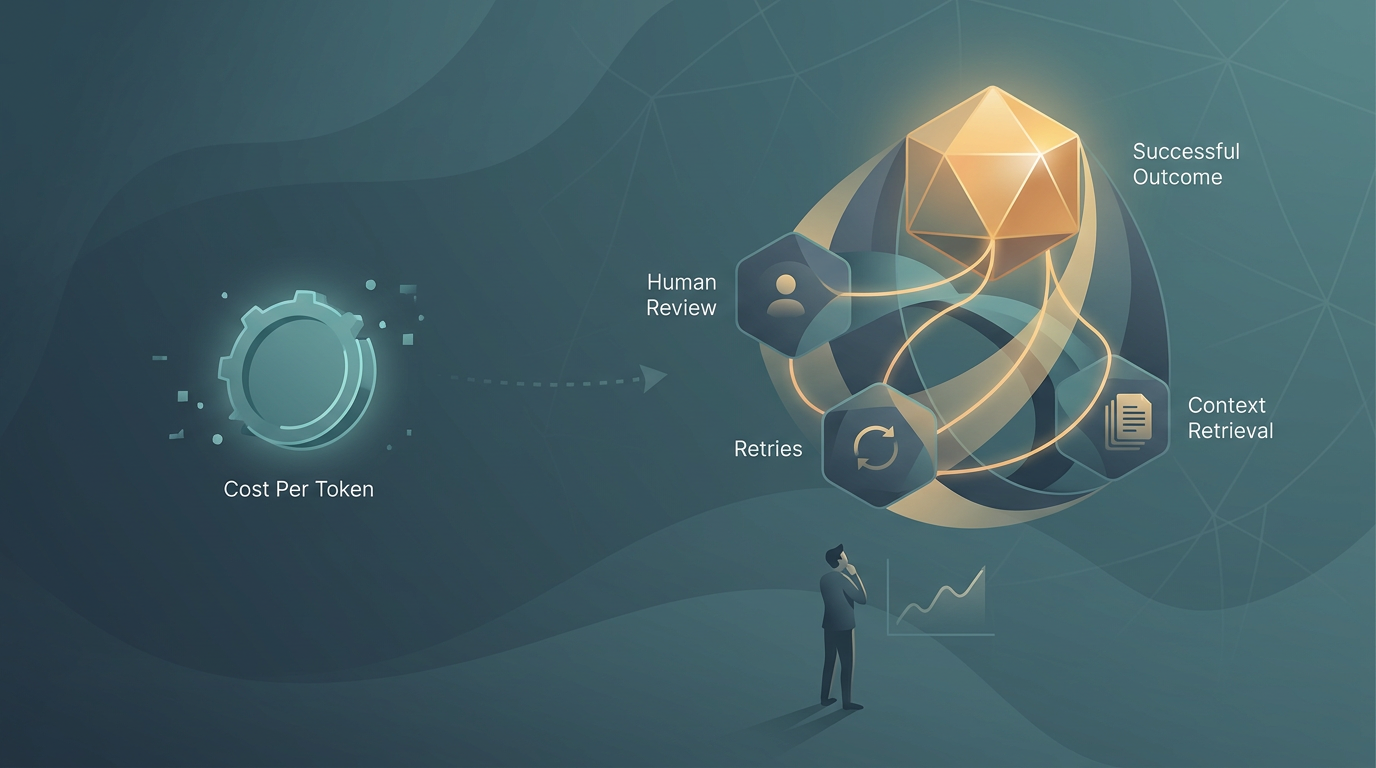
AI SaaS Unit Economics: Cost Per Successful Outcome
The true cost of one successful task in an AI SaaS product is not just the price of the LLM tokens used. It is the combined cost of the initial prompt, context retrieval, failed attempts, human-in-the-loop review, and customer support, divided by your overall task success rate. If you only measure token costs, your unit economics will appear artificially healthy until usage scales and hidden costs erode your margins.
For early-stage founders building AI products, shifting your metric from "cost per token" to "cost per successful outcome" is critical for sustainable growth and accurate pricing.
Why Cost Per Token is a Trap
LLM providers bill by the token, leading many founders to calculate their Cost of Goods Sold (COGS) based on a single ideal interaction. However, AI is probabilistic. Users will submit vague prompts, the model will hallucinate, and complex tasks will require multiple API calls (chain-of-thought, retrieval, and validation).
If a single ideal generation costs $0.02 in tokens, but it takes an average of three attempts, a database query, and occasional human intervention to get an output the user actually accepts, your true cost is significantly higher.
The Cost Per Successful Outcome Formula
To calculate the true cost of a successful task, you must account for the entire lifecycle of the generation.
True Task Cost = (Base Inference + Retrieval + Retries + Human Review + Support Allocations) / Success Rate
Hypothetical Worked Example: AI Contract Summarizer
Below is a hypothetical calculation for an AI SaaS that summarizes legal contracts. This illustrates how a $0.05 base token cost can quickly escalate into a $0.20 actual cost per successful outcome.
| Cost Component | Hypothetical Cost per Attempt | Notes (Hypothetical Assumptions) |
|---|---|---|
| 1. Base Inference (Tokens) | $0.05 | Combined input/output tokens for one standard contract. |
| 2. Retrieval / RAG | $0.01 | Vector database query and embedding costs. |
| 3. Retries & Refinements | $0.04 | Average of 0.8 retries per task (users asking for adjustments). |
| 4. Human Review / Validation | $0.05 | 1 in 10 tasks requires a $0.50 human-in-the-loop validation step. |
| 5. Prorated Support | $0.02 | Customer support tickets related to poor outputs, divided by total tasks. |
| Total Cost per Attempt | $0.17 | The raw cost before factoring in complete failures. |
Factoring in the Success Rate: In this hypothetical scenario, assume 85% of tasks result in a successful, accepted outcome, while 15% are abandoned by the user due to poor quality or frustration.
- True Cost per Successful Outcome: $0.17 / 0.85 = $0.20
By measuring the cost per successful outcome, you realize the feature costs 4x more than the base token estimation. This fundamental shift in unit economics must inform your business model. For guidance on translating these costs into a viable pricing strategy, review our guide on how to price your early-stage product.
Key Drivers of AI SaaS COGS
To optimize your unit economics, you need to track and manage the hidden drivers of AI costs.
1. The Retry Multiplier
Users rarely get what they want on the first try. Whether they are refining a generated image or tweaking the tone of a marketing email, every retry consumes tokens. If your UI encourages rapid-fire tweaking without guardrails, your retry multiplier will destroy your margins.
2. Retrieval-Augmented Generation (RAG) Overhead
Feeding context to an LLM requires vector search, database reads, and massive input token payloads. As your users' data grows, the context window required to answer their queries grows, linearly increasing your input token costs per task.
3. Human-in-the-Loop (HITL) and Support
For high-stakes workflows (like legal, medical, or financial analysis), AI cannot operate autonomously. If your product requires human review to guarantee quality, human labor becomes part of your COGS. Similarly, if poor AI outputs generate customer support tickets, those support costs must be factored into the unit economics of the feature.
Actionable Next Step
Audit your current AI features. Pull the logs for a cohort of users over the last 7 days. Instead of looking at total API spend, track the lifecycle of specific user goals. Calculate the average number of API calls, retries, and database queries required before the user accepts the output or abandons the task. Use this data to calculate your baseline Cost Per Successful Outcome today.
Map your AI SaaS unit economics and business model
Idea OS evaluates your startup across market sizing, ICP, competition, and more—then generates a Lean Canvas tailored to your evaluation.
Create my Lean Canvas →New to Idea OS? Start by evaluating your idea.