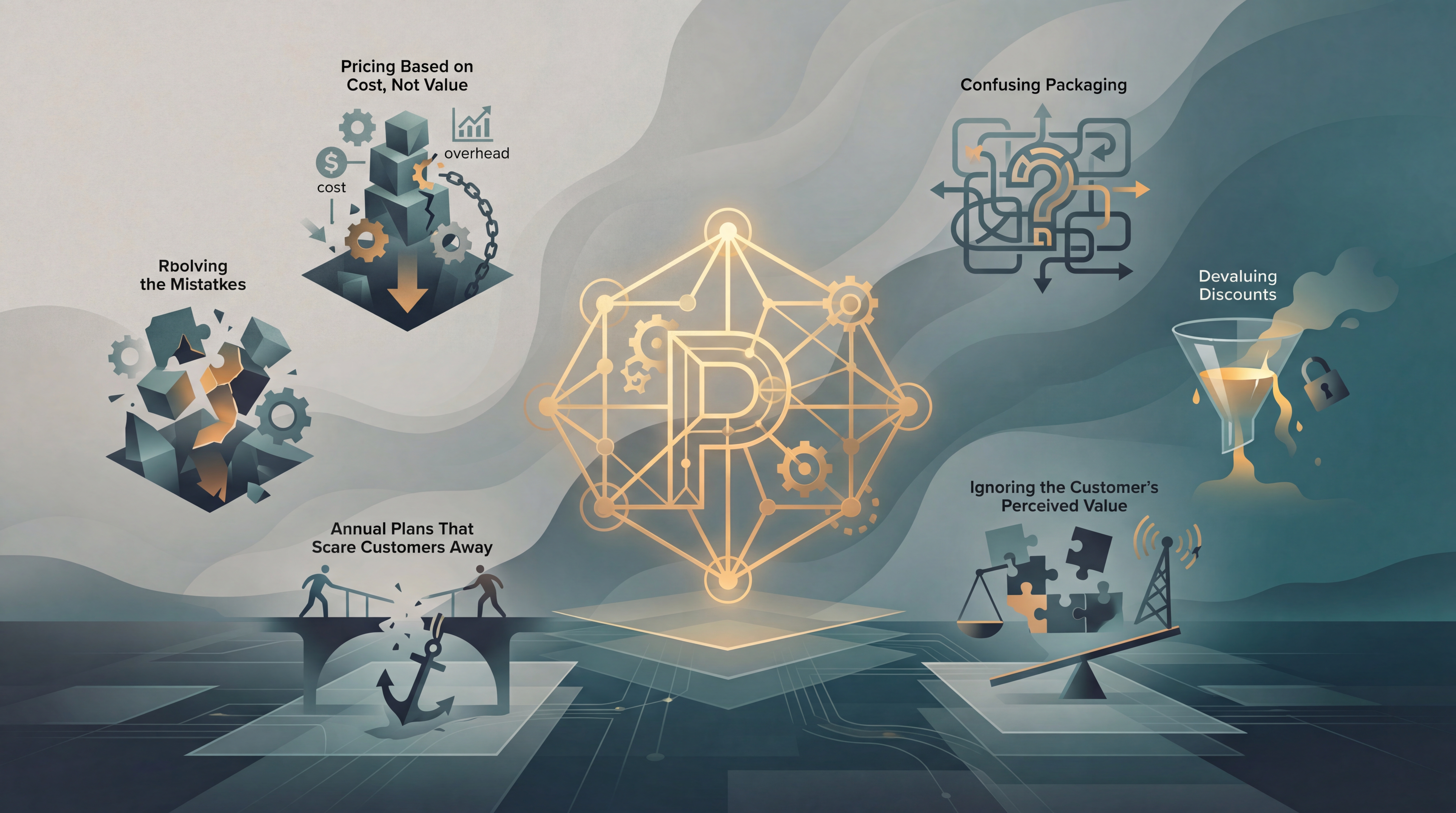
5 Fatal B2B SaaS Pricing Mistakes That Kill Deals
Your B2B SaaS Pricing Is More Than a Number
For an early-stage B2B SaaS founder, pricing feels like a dark art. Set it too high, and you scare away prospects. Set it too low, and you leave money on the table, devalue your product, and signal a lack of confidence. The truth is, your pricing is a core part of your product, brand, and go-to-market strategy. It communicates value faster than any sales deck.
Getting it wrong doesn't just hurt revenue—it can kill deals before they even have a chance. Prospects get confused, lose trust, or simply can't justify the cost relative to the perceived value. Let's break down the five most common B2B SaaS pricing mistakes and how you can avoid them to close more deals and build a sustainable business.
Mistake 1: Pricing Based on Cost, Not Value
This is the most common trap for technical founders. You calculate your server costs, support overhead, and development salaries, add a margin, and call it a day. This is cost-plus pricing, and it's a direct path to commoditization.
Your customers don't care about your costs. They care about their problems. They are buying outcomes, not your code. Value-based pricing anchors your price to the value your product delivers to the customer's business.
How to Fix It:
- Quantify the ROI: Does your software save them time? How much is that time worth? Does it increase their revenue? By what percentage? Does it reduce risk or prevent costly errors? Assign a dollar value to these outcomes.
- The 10x Rule: A common heuristic is that your product should provide at least 10x the value of its price. If your tool saves a business $5,000 per month in operational efficiency, a price of $500 per month feels like an incredible deal.
- Talk to Customers: The only way to understand perceived value is to ask. In customer interviews, ask questions like: "What would happen if you didn't solve this problem?" and "What's the budget for a solution like this?"
Mistake 2: Overly Complicated Packaging
Prospects land on your pricing page and see five different tiers, a dozen a la carte add-ons, and a feature matrix that looks like an Excel nightmare. This is the paradox of choice in action. A confused mind always says no.
Complexity creates friction. It forces the prospect to work too hard to figure out which plan is right for them, making it easier to just close the tab and check out a competitor with a simpler model.
How to Fix It:
- Stick to 3 Tiers (Max): For most early-stage SaaS, a three-tier structure (e.g., Starter, Pro, Enterprise or Good, Better, Best) is ideal. It provides a clear path for customers to self-select and upgrade.
- Align Tiers with Personas: Each tier should be designed for a specific customer segment. Your 'Starter' plan might be for small teams, 'Pro' for growing companies that need more advanced features, and 'Enterprise' for large organizations requiring security and compliance features.
- Use a Clear Value Metric: Base your tiers on a single, understandable metric that scales with customer value. Examples include:
- Per user/seat
- Usage (e.g., contacts, API calls, data storage)
- Feature-gating (unlocking specific functionality)
Mistake 3: Unstrategic and Inconsistent Discounting
In the early days, the pressure to land your first 10, 20, or 50 logos is immense. This desperation often leads to giving massive, ad-hoc discounts just to get a deal across the line. While it might feel like a win, it's a long-term strategic loss.
Aggressive discounting devalues your product, erodes margins, and sets a dangerous precedent. Your first customers become your price anchors; if they all paid 50% off, that becomes your product's real price in the market's mind.
How to Fix It:
- Create a Discounting Framework: Don't let discounts be random. Define clear, written rules for your sales team (even if your team is just you).
- Tie Discounts to Customer Value: Offer discounts in exchange for something valuable to you. Examples include:
- Annual Pre-payment: Offer 15-20% off (equivalent to 1-2 months free) for paying a year upfront. This dramatically improves your cash flow and reduces churn.
- Case Study/Logo Rights: Offer a small discount (e.g., 10%) in exchange for a public case study or the right to use their logo on your website.
- Multi-year Contracts: For larger deals, offer a slightly larger discount for a 2 or 3-year commitment.
- Hold the Line: Be confident in your value. If a customer isn't willing to pay a fair price, they may not be the right customer for you.
Mistake 4: Hiding Your Pricing Page
The infamous "Contact Us for a Quote" button. While it has its place for highly complex, true enterprise solutions, it's often a deal-killer for early-stage B2B SaaS. Hiding your price creates immediate friction and suspicion.
Prospects assume:
- It's incredibly expensive.
- You're going to put them through a high-pressure sales process.
- The price is arbitrary and changes depending on who's asking.
This prevents potential champions from doing their initial research and kills inbound momentum.
How to Fix It:
- Default to Transparency: For 90% of B2B SaaS, a public pricing page builds trust and helps qualify leads automatically. People who can't afford your product will self-select out, saving you time.
- Use a Hybrid Model: If you have a complex enterprise tier, it's perfectly acceptable to list your self-serve plans (Starter, Pro) with clear pricing and have a "Contact Us" call-to-action for the Enterprise plan. This gives you the best of both worlds.
Mistake 5: Fumbling the Annual vs. Monthly Choice
Many founders start by only offering monthly plans because it feels like a lower barrier to entry. While true, you miss out on two of the most powerful levers for a SaaS business: upfront cash flow and reduced churn.
Customers on annual plans are locked in for 12 months, giving them more time to see value and fully adopt your product. This dramatically increases their lifetime value (LTV).
How to Fix It:
- Always Offer Both: Present monthly and annual options side-by-side.
- Incentivize the Annual Plan: Make the annual plan the obvious choice. The most common and effective incentive is a discount, typically framed as "Get 2 Months Free."
- Default to Annual: Use visual cues on your pricing page to highlight the annual option as the "Most Popular" or "Best Value" choice. You can even use a toggle that defaults to showing the annual pricing first.
Pricing isn't a one-time decision; it's an ongoing process of discovery. By avoiding these common mistakes, you can build a pricing strategy that not only closes deals but also lays the foundation for a scalable, profitable B2B SaaS company. Start by focusing on value, keeping it simple, and being strategic.
Ready to integrate your pricing into a winning strategy? Let us help you get started.
Further reading
Build Your Go-To-Market Strategy
Idea OS evaluates your startup across market sizing, ICP, competition, and more—then generates a GTM Strategy Generator tailored to your evaluation.
Generate GTM Strategy Generator →New to Idea OS? Start by evaluating your idea.